PCD Vs Carbide who has better value?

PCD drills are considered high-end cutting tools, due to their rather complex manufacturing process and their higher market price compared to regular Tungsten Carbide drills.
In this ever-evolving composites materials market, the number of applications increase constantly, not only for the traditional aerospace segment, but also for Automotive, Wind turbines, Marine, Infrastructure and sports.
The use of PCD drills in composites is crucial for hole quality, process stability and cost effectiveness.
In this article we will explain why PCD drills are the best option an end user can choose for his composite application
You can divide the manufacturers of composite materials parts, which require hole making, into 3 types: End-users who use mainly PCD drills including regrinding services; End-users who use mainly CVD drills; End-users who use mainly carbide drills.
Tools price Vs. Process cost
While most buying decisions are price driven, there is no argument about end-users with low volume usage of drills and the best option for them probably is to search for the lower priced tool which complies to their requirements. In most of the times, it would be a Tungsten Carbide tool, which considered economical in price.
However, when large number of holes or large number of parts are about, the measurement of tool price only may be misleading. It is advisable in this case to look in a wider perspective.
The cost of cutting tools in an average manufacturing plant may vary between 5-10% of production cost, therefore saving the money on a chipper but less efficient tool is not worthwhile in most cases. The best measurement of tool effectiveness is by checking the entire machining process while measuring the cost of the tool divided by number of meters (in case of an endmill) or number of holes (in case of a drill).
When using CVD drills, the measurement is straight forward, by dividing the price of the tool to the average number of holes it is making. This would be the normal cost of the drill.
In case of using PCD drills, this measurement is not enough, since PCD drills can be resharpened few times and an overall life expectancy and overall number of usages must be measured.
But before we discuss this further, let’s try to remember the differences between Tungsten carbide, PCD tools and CVD diamond coated tools.
PCD Vs CVD Vs Tungsten Carbide

PCD (Poly Crystalline Diamond) is produced synthetically by sintering together many diamond particles, usually in the size of 2 to 30 microns of a meter, with a metal binder (usually Cobalt) at high temperature and high pressure. The hardness of the PCD is at the range of 6500-7000 Hv.

CVD Diamond (Chemical Vapor Deposition) – is a process of
coating Nano diamond particles on a Tungsten carbide substrate (tool) applying a typical layer thickness of 6 to 14 microns of a meter. The hardness of the CVD Diamond is at the range of 8500-9000 Hv.

Tungsten Carbide (TC) is a hard material compound with W and C double the density and stiffness of steel, used as sintered with cobalt as the binder, mostly to produce cutting tools. Typical hardness is 1500-1800 Hv.

Comparing these 3 tool materials, it is evident that PCD and CVD are much harder than Tungsten Carbide therefore much more wear resistant. There is an advantage to the CVD diamond coating in terms of hardness on the PCD, though much smaller.
When delamination is the failure criteria, CVD diamond drills are likely to perform better than the PCD wafer (segmental) drills due to the superior hardness of the cutting edge in minimizing delamination at the hole exit.
This is one of the major concerns in the drilling of composites in highly engineered parts in the Aerospace.
The TC drill is likely to wear very fast due to much lower hardness, so it creates more deflection and delamination than the PCD and CVD drills. It is known that tool life differences between TC tools and Diamond tools can be up to 25 times in favor of the diamond.
When hole diameter is the failure criteria, then the PCD drill is likely to hold longer than CVD drills. The reason for this is since CVD diamond is a coating implemented on top of TC substrate. When it eventually peels off, it would expose the tungsten carbide underneath and edge wear will accelerate rapidly.
The PCD, on the other hand, is a solid diamond. Wear development rate is rather fast at the very beginning when edge radius develops but then it stagnates for long period of time.
Another example where PCD have an advantage is when drilling a stack material like CFRP/Aluminum, where the exit hole is in the Aluminum. Delamination is a non-issue in this case, therefore PCD drill would be first choice since it will hold hole accuracy longer and can also be reconditioned few times (unlike CVD drills).
Another major advantage of the CVD diamond drill would be design flexibility. The CVD drill is manufactured in 5-6 axis grinding machine to a complete geometrical design and later is being diamond coated, whereas most of PCD drills in the market are based on straight segments which limit the design flexibility.
Design flexibility is critical when building a point geometry to tackle composites.
Wafer PCD vs. Full-nib PCD
Now we must explain the two different types of PCD drills: the Wafer drill and the Full-nib drill.
In the wafer (segmental) drill, PCD segment is in the drill center and drill geometry is built around it, while being limited to its shape and size.

On a Full-nib PCD drill, on the other hand, the PCD has a cylindrical solid shape on top of the carbide shank, therefore drill point design has no limitations.
Most of hole sizes in composites are in the range of 2.5mm to 8mm in diameter. This is the range of diameters where PCD Full-Nib drills can be most efficiently manufactured and utilized, since larger diamond nibs are quite expensive.

The new Helicon Full-nib PCD drill
Telcon has developed the New Helicon Drill for extended tool life, accuracy and repeatability while maintaining delamination-free results.


Unlike PCD wafer drill, The Full-nib PCD allows for flexible design. The new Helicon is designed with 2 point-angles with slower, more gradual penetration into the material.
The consequence of that is lower thrust force on the material and much lower delamination and deflection of the composite materials.

Case Study comparing PCD vs. CVD vs. Tungsten Carbide drills:
The application is drilling a CFRP unidirectional material, 5mm in thickness with diameter 4.87mm (.191″).
4 drills were tested:
- A tungsten carbide uncoated dagger style drill 4.87mm.
- A Helicon PCD Full-nib drill 4.87mm.
- A PCD wafer drill 4.87mm.
- A CVD diamond drill 4.87mm.

test setup
Drilling cutting conditions are based on common practice in drilling composites.
| RPM | Feed mm/min | |
| Tungsten carbide drill | 3800 | 180 |
| PCD Wafer drill | 6500 | 300 |
| PCD Helicon drill | 6500 | 300 |
| CVD diamond drill | 6500 | 300 |
Test criteria is the size of generated Delamination. Failure occurs when delamination is more than 1mm further from hole circumference.

Drilling results were monitored every 200 holes for the diamond drills and every 100 holes for the TC drill. Then, holes were checked and marked for G/NG.
Final test results are gathered in the table and diagram below:
| Number of holes until delamination criteria | Hole size reduction from 1st to last hole (µ meter) | |
| Tungsten carbide drill | 85 | 25 |
| PCD Wafer drill | 760 | 10 |
| PCD Helicon drill | 1730 | 15 |
| CVD diamond drill | 1480 | 20 |

It is evident that the Tungsten carbide drill has much lower tool life as expected. The reduction in diameter from 1st to last hole is also the largest.
The Helicon drill has the best tool life while the CVD drill is second. The Wafer drill is approx. 50% in life compared to the Helicon drill. It is noticeable that the CVD drill has higher hole
diameter reduction than the PCD drills.
Cost comparison:
To better emphasize the significance of these results, let us make a cost comparison based on this test:
| Tool cost $ | Number of resharpening | Resharpening cost $ | Total cost $ | Total number of holes | Total cost/hole $ | |
| Tungsten Carbide Drill | 45 | 3 | 15 | 90 | 340 | 0.265 |
| PCD Wafer Drill | 181 | 3 | 63 | 370 | 3040 | 0.122 |
| PCD Helicon Drill | 198 | 3 | 69 | 405 | 5190 | 0.078 |
| CVD Diamond Drill | 132 | N/A | N/A | 132 | 1480 | 0.089 |
Summary and conclusion:
1. It is shown that PCD Full-nib drill, Helicon, is superior in tool life and normal cost (cost per hole).
2. It is shown that CVD drills are a very good solution when it comes to preventing delamination, although cost per hole is slightly in favor of the Helicon Full-nib drill. However, when hole accuracy is held within thin boundaries, the Full-nib drill outperforms the CVD drill.
3. It is also shown that the use of Tungsten carbide drills cost 3 times more than the use of PCD Full-nib drill, therefore advisable to be used only where there are fewer holes per part or lower number of parts to produce.
4. Setup time is excluded from this comparison, however if to be added, differences would be even higher, since tungsten carbide drills would need much more frequent replacements and will consume more machine idle time.
5. Feed rate comparison is excluded as well, and if considered, the Diamond drills are 67% faster in table feed, so machine time can be saved.
PCD Countersink Vs. Carbide Countersink

Both PCD and carbide countersinks are commonly used in assembly and manufacturing processes, but what are the advantages of each type? what is the use case and when will we need to make the choice? in this article we will cover some of these questions in depth.
What is a Countersink tool?
A Countersink (in short, CSK) is a cutting tool with edges tilted to a certain angle to create a chamfer at a certain size. The chamfer is mostly at the end of a hole in a manufactured part. The chamfer holds the head of a connecting element such as a bolt, rivet, or a screw, to have the head of this element align with the part surface.


What are Countersink tool types?
There are multiple applications for Countersink tools, in almost every industry, however we would like to focus on the usage in the aerospace airframe industry.
Countersink is a very common tool in the assembly lines of airplanes, since all body parts are attached and connected with rivets. The head angle of the rivet is 100 or 130 deg mostly and the Countersink tool angle is built accordingly by the Countersink manufacturer. Countersinks can be either with an integral pilot which is a part of the Countersink body, or with an exchangeable pilot, where the pilot is a made separately and inserted to a central hole in the Countersink . The pilot stabilizes and centers the position of the chamfer relative to the existing hole centerline in the part. The Countersinks are being held inside a stop-cage device, which allows setting up the depth of the Countersink penetration, hence the size of the chamfer given in the spec.


What applications with Countersink are at the airframe assembly lines?
There are two main applications for Countersinks, one which involves connecting parts made from Aluminum and second, parts made from FRP (Fiber reinforced plastic). There can be also a combination of both. There is not much difference in the way the Countersink tools are used in these two applications, there is, though, a major difference in the Countersink type. While in Aluminum parts, recommended Countersinks are with tipped carbide segments, on the Composites parts, recommended Countersinks are with PCD tipped segments.


PCD Countersink VS. Carbide Countersink
Understanding the difference between PCD and carbide, can explain some common mistakes end users are making while using the wrong countersink type for their application.
Composite materials are extremely abrasive due to the hard fibers inside their matrix especially in carbon fibers (CFRP). Choosing a carbide tipped CSK for this application is mistake no. 1.
PCD is 3-4 times harder than carbide. This explains the wear resistance advantage of PCD vs. Carbide in cutting composites. PCD tools can outperform a carbide tool by at least 20 times and show consistent quality results over much longer time compared to carbide.

People often compare only tool price and while PCD CSK may cost 2-3 times the price of Carbide CSK, that is mistake no. 2.
When using PCD Countersink vs. Carbide Countersink you would benefit from:
- Longer tool life by a factor of 20 at least.
- Consistent part quality over much prolonged time.
- Fewer setups.
- PCD CSK can have the option of resharpening and re-use at least twice.
Let’s compare “apples to apples”:
One PCD Countersink would in average make 1500 holes in CFRP, while carbide will make around 60 holes.
If we consider 2 re-condition cycles for PCD Countersink , that is a total of 4500 holes in one life span of a PCD Countersink.
| Carbide Countersink | PCD countersink | |
| Average cost, 1/2″ integral countersink, 100deg | 35$ | 80$
|
| Re-condition cost | N/R | 2×28$ = 56$ |
| Total Setup cost (in average 5min. to replace a tool and calibrate), average hourly cost of 60$ | For 4500 holes, 75 times CSK must be replaced, that is 375 minutes, or 6.25 hours, which ultimately cost 375$ | Total of 3 setup cycles, that is 15 minutes
15$ |
| Total tool cost for making 4500 holes | 35×75+375 = 3000$ | 80+56+15 = 151$ |
| Tool cost/hole | 3000/4500 = 0.67$ | 151/4500 = 0.033$ |
| Savings/Hole with PCD | 95% cost saving! |
There should be no doubt now, that PCD Countersinks are much better for using on composites.
Telcon Diamond Ltd. manufactures both types of Countersink tools made from the best PCD and carbide grades.
We can assist with your application – please contact us on:
Composites – The 5Ws – Part 2
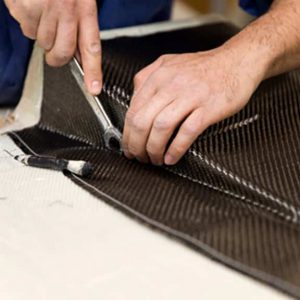
Nature of Thermoplastic composites in Aerospace
This article will explain about the two major composites matrices which are in use in the industry and particularly in the aerospace.
Most composite raw materials are purchased ready to be used by the part manufacturers. There are two major composites resin groups, ready to be used, which require different manufacturing methods; Thermoset matrix and thermoplastic matrix composites.
Thermoplastic composites are usually heated and molded or pressed into a mold to receive their final shape, then cooled and to final part is shape. The process involves only heating and cooling. The process is rather short and reversible. Since heating must take place immediately for the impregnation process, most of thermoplastic composites process are automatically done, involving in-situ consolidation, either in compression molding, filament winding
Thermoset composites layers are laid one on top of the other manually or automatically to the final part width and then oven-cured under vacuum bag to generate chemical reaction which brings them to their final solidification stage and properties. The process is longer and non-reversible.

The table below shows major differences between the two composites types:
| Thermoset Composites | Thermoplastic Composites |
| Generated during curing (chemical change) |
Generated by heating and cooling of the plastic matrix (physical change) |
| Non-reversible | Reversible |
| Easier to impregnate the fibers into the matrix in room temperature, Easier to process to final shape, thick to thin walls capabilities. | Impregnation can be done only during heating; therefore, reaching to final shape is more complex and costly. |
| Longer process cycle time due to Oven curing which takes few hours | Shorter process cycle time, no curing required, however, higher temperatures are required for the processing |
| Hard and rigid | Tougher and more flexible, therefore higher impact resistance |
| High fatigue strength | Lower Fatigue strength |
| Higher heat resistance | Lower heat resistance |
| Higher dimensional stability | Lower dimensional stability |
| Used mainly with continuous fibers | Used mainly with discontinuous fibers |
| Non-recyclable | Recyclable |
| Raw material must be stored in a specific environment and has limited shelf life | Regular storage conditions, unlimited shelf life |
| Cannot be welded, must be assembled with rivets and fasteners (adding the need for hole drilling and countersinking) | Under specific conditions, can be welded to other thermoplastic part |
To date, in Aerospace applications, more than 95% of prepregs are thermoset.
The nature of thermoset Composites
Thermoset composites have been successfully manufactured for aerospace since the 1960’s, and the knowledge is vast and mature. In addition, highly investment has been put during these years to develop processes, materials, equipment, gigs, training and testing for implementing the thermoset composites in aerospace parts.
Major structures in the Boeing 787, the Airbus A350 and Lockheed Martin F35 almost exclusively thermoset composites. Structural airplane parts such as fuselage, wings, beams, tails and others are made from Thermoset composites.
In the automotive, sports cars, supercars and some mass production cars, like BMW i3, are using thermoset composites.
All the energy windmills blades are made from thermoset composites.
Thermoplastics composites, on the other hand, were firstly used by Airbus on the A340, A380 and later, also on the A350. Up until recently, thermoplastic composites on airplanes have been used only for smaller parts like clips or brackets. This is gradually changing as better materials and processes are being developed while thermoplastic composites are being used in bigger parts in components like the horizontal stabilizer of the Leonardo AW169 helicopter, the rudder and elevators on the empennage of the Gulfstream G650. Additional parts were developed such as the fixed wing leading edge, keel beams, interior components, engine pylons, access doors, aircraft flooring and a variety of molded interior parts.

In fact, thermoplastic composites offer number of important advantages over thermoset:
It has higher degrees of impact toughness. It does not require special storage conditions. It does not need to be cured in autoclave for many hours. Two or more parts can be welded together saving the use of rivet connection (drilling & countersinking). And, it is more ecological since it can be recycled.
Why you will need high quality tools?
There are disadvantages for thermoplastics, which hold back a greater usage of these materials. The main disadvantages: impregnation of fibers can be done only during heating; therefore, reaching to final shape is more complex and costly. In addition, it has lower dimension stability than thermoset composites and has lower heat resistance.
Due to the nature of aerospace industry working under stringent regulations, it would still take years of investment in research and testing until thermoplastic composites will conquer higher volume of usage as compared to thermoset composites.
Telcon Diamond has developed over the years PCD and CVD solutions for both thermoset and thermoplastics composites. While thermoplastic composites involve less drilling and countersinking, the milling (routing) operation of these materials can be challenging since these parts are more flexible and elastic, therefore milling is less stable and tool geometry must be designed accordingly.
Composite Materials – The 5Ws – Part 1

What are Composite materials?
Composite materials are synthetic materials that are made from two or more material components with different physical or chemical properties that, when combined, produce a material with different (usually better) characteristics than each of the individual components, composite materials are commonly designed to serve specific purpose and the attributes of the material are designed to serve this purpose, for example carbon fiber materials that are designed for light weight and High strength with high brittleness.
Composite materials are in use in various applications in Aerospace, Automotive, Energy, Sports, Construction and more.

The fundamental advantage of composite materials is higher strength to weight ratio, which brings added value in the aforementioned applications.
In most cases, composite materials are constructed from two main materials: fibers of strong material, such as Glass or Carbon and a polymer matrix material, such as epoxy, which bonds the fibers together in a certain shape.
The table below summarizes the majority of composite material options:
| Fibers | Polymer Matrix (bond) |
| Carbon fiber | Epoxy |
| Glass fibers | Phenolic |
| Ceramic fibers | Polyimide |
| Polymer fibers (Kevlar, Polyethylene) | Poly-ether-ether-ketone (PEEK) |
| Tungsten fibers |
The two most advanced composite materials in use are Carbon Fibers, also called CFRP (Carbon Fiber Reinforced Polymer) and Glass fibers, also called GFRP.

About the Common types of Composite materials
Mass production of glass strands was accidentally discovered in 1932 when Games Slayter, a researcher at Owens-Illinois, directed a jet of compressed air at a stream of molten glass and produced fibers.
It wasn’t until the late 1950’s that high tensile strength carbon fibers were discovered. Rayon became the first precursor used to create these modern fibers. Ultimately, it was replaced by more effective materials such as polyacrylonitrile (PAN).
Between the two, GFRP is lighter and stronger, however, more expensive, therefore in use mostly in Aerospace and in luxury and sports cars and professional sport equipment.
Manufacturing process of composite materials involves three main technologies; the manufacturing of the fiber, the manufacturing of the polymers and the manufacturing of the combined composite material itself.
The process for making carbon fibers, which is part chemical and part mechanical involves the use of a precursor (About 90% of the carbon fibers produced are made from polyacrylonitrile, PAN) which is drawn into long strands or fibers and then heated to a very high temperature without allowing it to come in contact with oxygen. Without oxygen, the fiber cannot burn. Instead, the high temperature causes the atoms in the fiber to vibrate violently until most of the non-carbon atoms are expelled. This process is called carbonization and leaves a fiber composed of long, tightly interlocked chains of carbon atoms with only a few non-carbon atoms remaining.
It’s all in the fiber materials
Fiber reinforced composite materials can be divided into two main categories normally referred to as short fiber-reinforced materials and continuous fiber-reinforced materials.
Continuous reinforced materials will often constitute a layered or laminated structure. The woven and continuous fiber styles are typically available in a variety of forms, being pre-impregnated with the given matrix (resin), dry, uni-directional tapes of various widths, plain weave, harness satins, braided, and stitched.
The short and long fibers are typically employed in compression molding and sheet molding operations. These come in the form of flakes, chips, and random mate (which can also be made from a continuous fiber laid in random fashion until the desired thickness of the ply / laminate is achieved).

In the next article we will discuss different manufacturing methods of composite materials, their pros and cons and their use in the industry.
More info